
Get Involved in the Movement


Current Events in Animal Law
Banning the Export of Live Horses for Slaughter
Despite a 2021 federal government promise to ban the export of live horses to Japan for slaughter, the practice continues. Bill C-355 remained stalled in the Senate, and failed upon the suspension of Parliament earlier this year. Ending this practice has not only become popular among animal advocacy groups in Canada, but also the majority of the electorate, making it an urgent high-profile issue. Current efforts to end this practice include a private prosecution brought against Carolyle Farms, a live-horse exporter in Manitoba. It is alleged that the farm "[...] exceeded the 28-hour maximum time live horses can be transported without food, water and rest." A July 2025 report found that between January 2021 and July 2025, all shipments from Winnipeg to Japan exceeded the legal 28-hour time limit, and 60% of shipments from Edmonton also exceeded this limit. Check out CBC's reporting on the current state of the lawsuit.

Photo credit: Canadian Horse Defence Coalition.
Secret Dog and Pig Experiments at St. Joseph’s Hospital Sparks Ethical Debate
Dogs and pigs at St. Joseph’s Hospital in London, Ontario, have been secretly used and euthanized in heart research studies, according to recent investigative reports and whistleblower accounts. The Lawson Research Institute at the hospital induces heart attacks in dogs and puppies, then kills them to extract their hearts for further study, with procedures lasting up to three hours. The hospital has kept the research program discreet, transporting dogs in covered crates with heavy security, and playing loud music to mask barking. Whistleblowers describe distressing conditions, with dogs caged for most of the day, lacking proper beds, and exhibiting signs of distress post-surgery. Public reaction in London and beyond has been one of anger and sadness, spurring protests and calls for more humane treatment, including rehoming the dogs after experiments rather than euthanasia. Animal rights organizations argue the research is both unnecessary and outdated, noting alternatives used internationally and challenging the hospital’s claims that such animal models are essential for cardiac imaging studies. The hospital defends its practices, stating the studies are ethically reviewed and necessary for medical advancement, while emphasizing animal welfare protocols and strict oversight. The controversy highlights a broader debate regarding the ethics, necessity, and transparency of animal testing in Canadian medical research, with some experts, advocacy groups, and members of the public demanding change in both local practice and national policies: •Bill 75 (Keeping Criminals Behind Bars Act) was introduced in Ontario on November 25, 2025, and this legislation proposes to ban invasive medical research on dogs and cats in Ontario, with specific exceptions for veterinary purposes •Proposal 52653 was released to amend the Animals for Research Act and regulations •The legislation also prohibits breeding cats and dogs in Ontario for research purposes •Multiple research facilities have been placed on probation by the Canadian Council on Animal Care (CCAC), including the University of Ottawa and Nucro-Technics in Scarborough •In November 2025, it was revealed that Nucro-Technics imported dogs from Ridglan Farms (Wisconsin) for over 13 years, despite ongoing allegations of animal cruelty at that facility
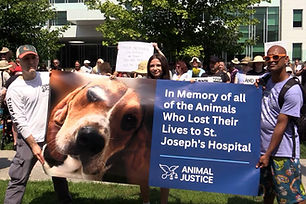
Photo credit: Brent Lale/CTV News London
Fate of Animals Left at Closed Marineland Canada
As of December 2025, Marineland remains closed and is actively selling off its amusement rides, but the future of the animals still onsite, including 31 beluga whales (the last remaining captive whales in Canada), four dolphins, three seals, two sea lions, and a population of black bears, is uncertain and highly contested. Marineland was found guilty in 2024 of animal cruelty charges related to its poor care of three young black bears. Ontario’s Animal Welfare Services has conducted over 220 inspections since 2020 and previously found marine mammals to be in distress due to substandard water conditions. However, most specifics on enforcement actions remain undisclosed. •In October 2025, Marineland threatened to euthanize 30 beluga whales unless the federal government provided financial assistance or approved their transfer to China •Federal Fisheries Minister Joanne Thompson denied the export permit to China, stating she could not in conscience approve the export. •As of mid-December 2025, the fate of the 30 belugas remains uncertain, with Animal Welfare Services confirming they were alive as of Tuesday, December 17, 2025 •Experts have stated the belugas cannot survive outside captivity as they cannot hunt for themselves and could spread disease •The financially troubled park is reportedly spending $1 million per month to care for the whales •The park is no longer open to the public and is preparing for a potential sale

Photo credit: Chris Young/The Canadian Press
Cage-Free Promise Abandoned by Nearly All Major Grocers
Over the past decade, Canada’s largest grocers and food brands pledged to sell only cage-free eggs by 2025 in response to mounting public and advocacy pressure. However, by 2021–2024, nearly all major grocers quietly backed out or delayed these commitments, citing industry readiness and costs. Instead, the industry adopted revised animal welfare codes that phase out conventional battery cages only by 2036 and permit transitioning to “enriched” cages rather than true cage-free systems. These codes are voluntary, not law, and are largely unenforceable. Animal welfare organizations criticize this approach as inadequate, calling the enriched cages little better than the originals and claiming Canada is falling behind the United States and Europe, where stricter bans and higher welfare standards are already in force. There are ongoing calls for a true end to cages in the Canadian egg industry and for more meaningful, enforceable animal welfare legislation.

Photo credit: Global Compassion Coalition
Ontario Proposes Landmark Ban on Invasive Research on Cats and Dogs
Bill 75 introduced November 25, 2025, proposes to ban invasive medical research on dogs and cats in Ontario. The bill defines invasive medical research as procedures that alter an animal's "physical integrity," cause "significant impact" to physiological systems, or result in moderate to severe pain, extreme distress or death. Concerns exist about loopholes that would allow continued importation of dogs and cats from other jurisdictions for research.

Photo of dogs in a cage, taken by a whistleblower at the Lawson Research Institute at St. Joseph’s Health Care in London. Photo and info retrieved from: ijb.utoronto.ca/news/ontario-unveils-legislation-to-restrict-invasive-medical-research-on-dogs-and-cats/
Ontario Government Expands Cruel Dog Hunting Pens Despite Strong Opposition
In October 2024, Ontario opened a 90-day application period for new "train and trial area" licenses. These are penned dog hunting facilities where wild animals (coyotes, foxes, rabbits) are kept captive and used as live bait to train hunting dogs. A 2023 Animal Justice investigation revealed that despite claims that animals aren't harmed, dogs frequently chase and maul live animals, and facilities must regularly restock with new coyotes because dogs catch and kill them. In June 2025, Animal Justice sued Ontario over three licenses that appear to violate regulations by allowing prohibited dog breeds to hunt foxes in undersized pens.
